Gotham City’s social decay
Batman the Dark Knight Returns 10th Anniversary Edition HardcoverGotham City’s social decay is the central condition that makes the return of Bruce Wayne / Batman necessary and politically dangerous. The city’s crisis appears through recurring crime, frightened or exhausted institutions, sensational public discourse, and the replacement of lawful authority by improvised force. As Gotham moves from chronic decline to blackout, martial law, and nuclear winter, its disorder becomes a contest over who can define safety and command obedience.
A City in Long Decline
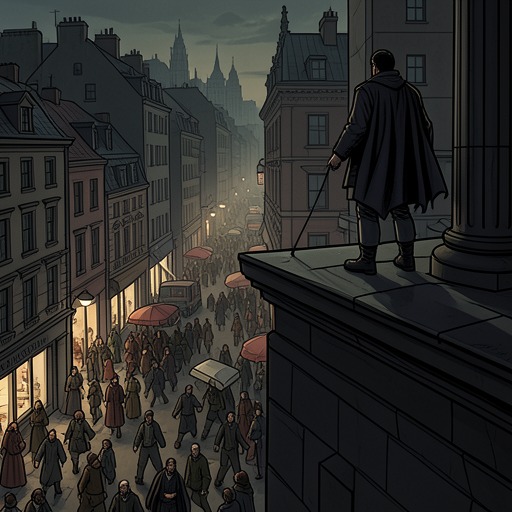
Gotham City is introduced not as a stable civic community temporarily interrupted by crime, but as a society whose ordinary structures have been eroding for years. The opening crisis places public violence, social anxiety, and political failure in the same field, while the aging Bruce Wayne / Batman observes a city that has learned to endure danger rather than overcome it. The persistence of this condition explains why his retirement cannot produce genuine peace: his absence removes a feared but effective counterweight without repairing the institutions that had depended on his presence.
The city’s decline is also mediated through the public sphere. News reports, official commentary, and televised discussion turn crime into a spectacle and shape how citizens understand both the danger and the possible remedies. Gotham City’s residents are therefore not only victims of disorder; they are participants in a climate of fear in which dramatic claims and visible force can appear more credible than slow institutional reform. The narrative repeatedly contrasts the language of public order with the reality of streets that remain vulnerable to organized violence.
Crime, Fear, and Institutional Failure
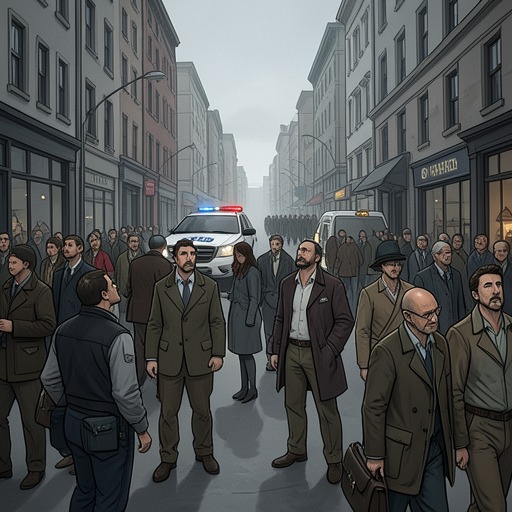
The rise of the Mutant Gang transforms Gotham’s general insecurity into a recognizable regime of intimidation. The gang’s power is measured not simply by its attacks but by the way its presence alters the city’s behavior: ordinary people retreat, authority is challenged, and the Gotham City Police Department struggles to make its legal mandate effective. The Mutant Gang’s rule demonstrates how quickly a weakened civic order can be displaced when an organization possesses cohesion, fear, and a visible leader.
The response to this crisis exposes a second layer of decay. The authorities can name the emergency, report on it, and attempt to contain it, but they cannot restore confidence through procedure alone. Bruce Wayne / Batman’s intervention therefore enters a vacuum created by institutional incapacity. His methods are illegal and coercive, yet the city’s desperation allows them to acquire a practical legitimacy that the official apparatus no longer commands. Gotham’s problem is consequently not only that violence exists; it is that lawful authority has become unable to persuade citizens that it can protect them.
From Emergency to Political Vacuum
The crisis intensifies when Gotham City suffers a blackout and the wider world moves toward nuclear winter. The blackout removes the ordinary infrastructure through which the city is governed and connected, making the fragility of its social order physically visible. With communications, policing, commerce, and routine administration disrupted, the city enters an exceptional condition in which survival and security eclipse normal legal expectations.
Under these circumstances, control shifts among rival authorities. The Gotham City Police Department remains associated with formal law, while Bruce Wayne / Batman organizes resistance and practical relief outside that law. Later, the Sons of Batman emerge from the movement around Batman and take over Gotham City, converting a symbolic allegiance into a force capable of occupying civic space. Their rise shows that Batman’s authority has consequences beyond his own actions: the legend can mobilize people, but it cannot guarantee that those mobilized will reproduce his limits or his conception of justice.
The city’s disorder also becomes entangled with larger political and military conflict. The confrontation between Bruce Wayne / Batman and Clark Kent / Superman is connected to a world in which governments respond to instability through overwhelming power, while Gotham remains exposed to the consequences. The city is not isolated from national or international violence; it is where those failures are experienced at street level, by citizens who must live amid the aftermath of decisions made elsewhere.
Restoration Through Force and Collective Action
Gotham’s partial recovery is initiated through action rather than a return to normal administration. Bruce Wayne / Batman organizes Gotham’s citizens to restore order after the blackout, and the Sons of Batman participate in a broader attempt to prevent the city from collapsing into permanent chaos. This process complicates any simple division between lawful government and criminal disorder. The old institutions have failed, but the replacement is initially a network of personal loyalty, discipline, and force.
The restoration therefore carries an unresolved question of legitimacy. Batman’s intervention can stop immediate violence and give frightened citizens a model of collective action, yet it remains dependent on his exceptional identity. The Sons of Batman inherit the movement’s symbols and energy, but their takeover also reveals the danger of political succession without formal accountability. Gotham is rescued from one form of domination while remaining vulnerable to another, because the city’s underlying need for authority has not disappeared.
Meaning and Ending
Gotham City’s social decay gives the story its deepest structural contrast: the city is visibly failing at the moment when Bruce Wayne / Batman becomes physically older, yet his return produces renewal precisely because the crisis has made passivity intolerable. His aging, James Gordon’s departure from active service, and Carrie Kelley / Robin’s emergence place Gotham’s future between exhausted institutions and a new generation shaped by Batman’s example.
The city’s decline also clarifies the moral ambiguity of Batman’s role. He opposes predatory violence and helps citizens recover agency, but he does so by suspending ordinary boundaries and concentrating power in a single figure. Gotham’s eventual movement toward order is thus neither a clean restoration nor a simple victory. It is a transformation born from emergency, collective mobilization, and contested authority, leaving the city changed but still marked by the conditions that made Batman’s return possible.